
Golf Penalties Explained
Few things wind a golfer up more than someone on the course who imposes the rules wrongly. The cure is simple: Know them yourself. Here is what yellow stakes, red stakes and white stakes really mean, what a lost ball actually costs you, and the penalty rules that get misquoted on the course every single weekend.
Why penalties matter, and why golfers get them wrong
Golf's penalty rules are not as complicated as they first appear. Most arguments on the course involve the same few situations: Yellow and red penalty areas, out of bounds, lost balls and provisional balls. This guide explains the available options and clears up some of the older rules that golfers still quote today.
Yellow Stakes: Penalty Areas

Yellow stakes (or yellow lines) mark a penalty area, most often a pond, lake or stream that sits across your line of play. If your ball is inside the yellow line, even if it is dry and playable, it is in the penalty area. You then have three options.
- Play it as it lies, no penalty. Since 2019 you may ground your club in a penalty area, touch the water, take practice swings that brush the ground, and remove loose impediments like leaves and stones. The old water hazard rules banned all of this, and many golfers still wrongly believe the ban applies.
- Stroke and distance, one penalty stroke. Go back and play again from where you hit the previous shot.
- Back on the line relief, one penalty stroke. Find the point where your ball last crossed the edge of the penalty area, draw an imaginary line from the flag through that point, and drop anywhere on that line going backwards, as far back as you like.
Notice what is missing: There is no sideways drop from yellow stakes. That option belongs to red penalty areas only, and mixing the two up is one of the most common rules mistakes in club golf. The reference point for your relief is always where the ball last crossed the edge of the penalty area, not where it splashed down or came to rest.
What is Back on the Line Relief?
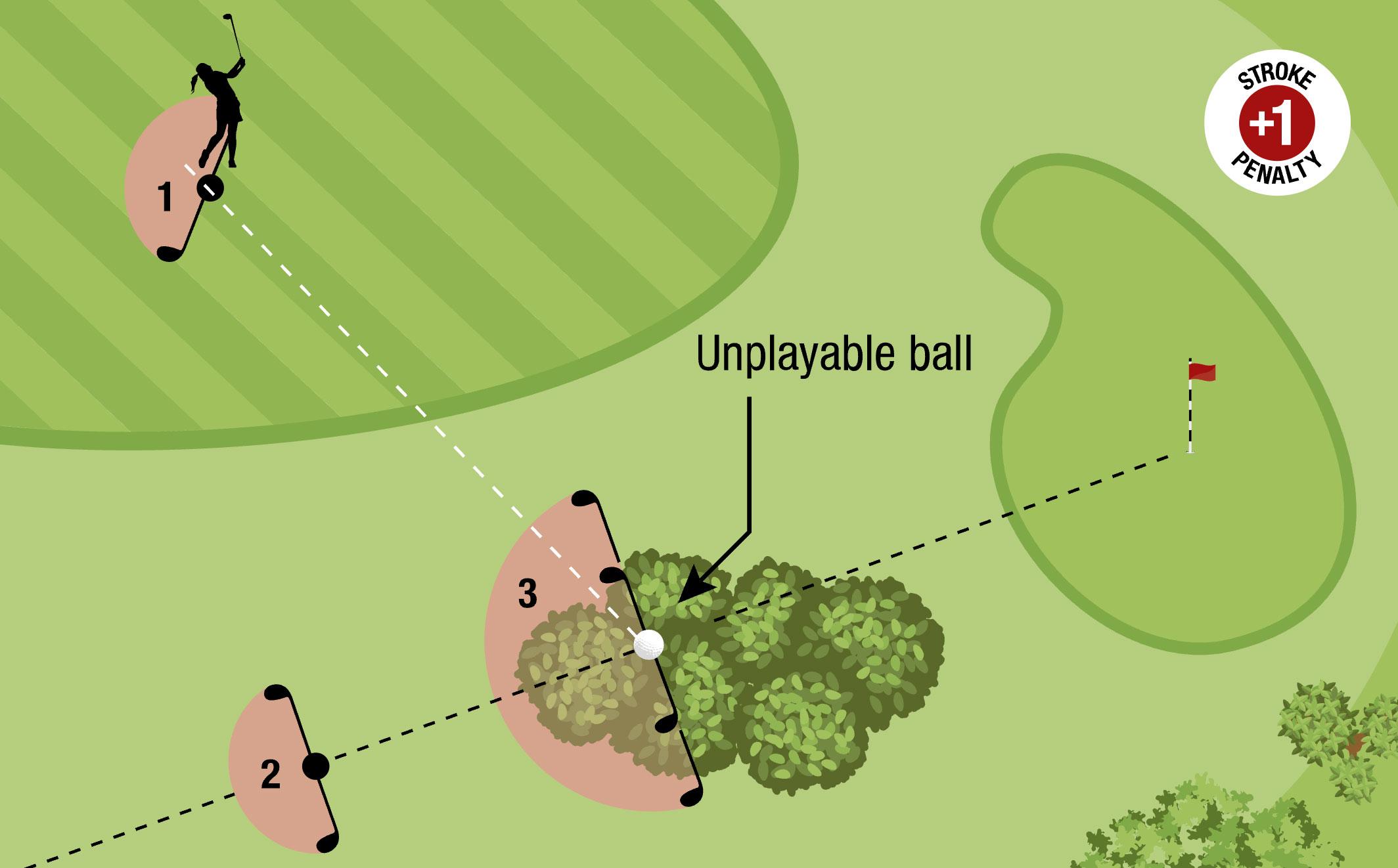
Back on the line relief appears in both penalty area options and the unplayable ball rule, and it is worth pausing on because so many golfers set the line up wrongly. The line is drawn to the pin, not to the tee. You take the hole itself as one end, your reference point as the other (for a penalty area, the point where the ball last crossed the edge), and extend that line backwards, away from the hole, as far as you want to go.
In other words, imagine standing behind the trouble and keeping the flag and your reference point lined up in front of you. Anywhere on that line going backwards is available to you. Where you played the shot from is irrelevant: The tee, the fairway or wherever the ball came from plays no part in the geometry. Golfers who march back towards the tee to drop are often nowhere near the correct line, and that is playing from a wrong place, which costs two penalty strokes in stroke play if they go ahead and hit it.
The procedure itself was simplified in 2023: Drop the ball on the line, and it may come to rest up to one club length in any direction from where it first touches the ground, even a touch nearer the hole than the exact spot it landed. Going a long way back is often the smart play too. An extra twenty yards can buy you a full swing with a club you trust instead of an awkward half shot over the same water that just cost you a stroke.
Red Stakes: Lateral Penalty Areas
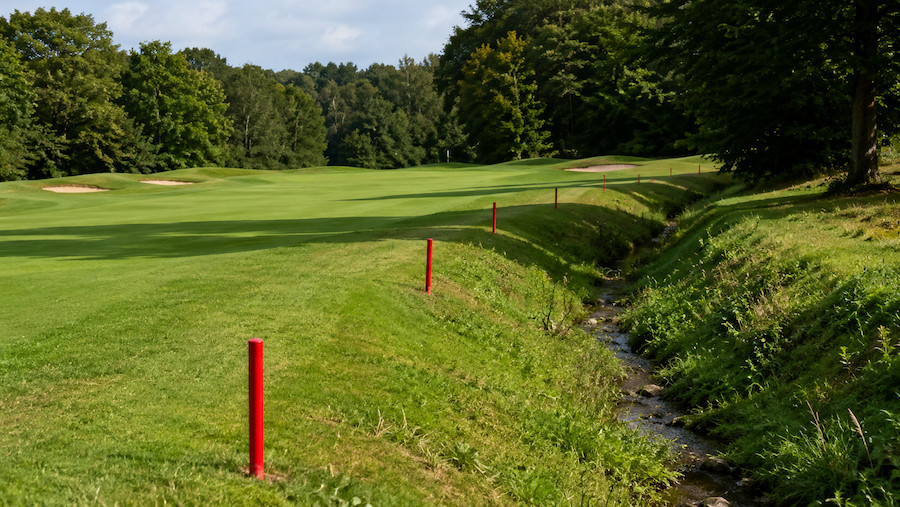
Red stakes mark a red penalty area. These are often found beside a fairway or green, where back on the line relief may be inconvenient: A stream down the edge of a fairway, a ditch, a gully, or an environmental area. Red penalty areas give you the same options as yellow ones, plus lateral relief within two club lengths.
- Play it as it lies, no penalty.
- Stroke and distance, one penalty stroke.
- Back on the line relief, one penalty stroke.
- Lateral relief, one penalty stroke. Drop within two club lengths of the point where the ball last crossed the edge of the penalty area, no nearer the hole. Club lengths are measured with the longest club in your bag other than your putter, so in practice your driver.
The one everyone gets wrong: No opposite side drop
Older golfers will remember being allowed to drop on the opposite side of a lateral water hazard, equidistant from the hole. That option was removed in 2019. Unless the club has adopted a specific local rule for that hole, the opposite margin is out. If a playing partner insists you can hop across the ditch and drop there, they are quoting a rule that no longer exists.
One more point worth banking: Whether the water is yellow or red, the penalty is the same, one stroke. Finding water is annoying but it is the cheapest penalty in golf. The expensive ones are coming next.
What is Lateral Relief?
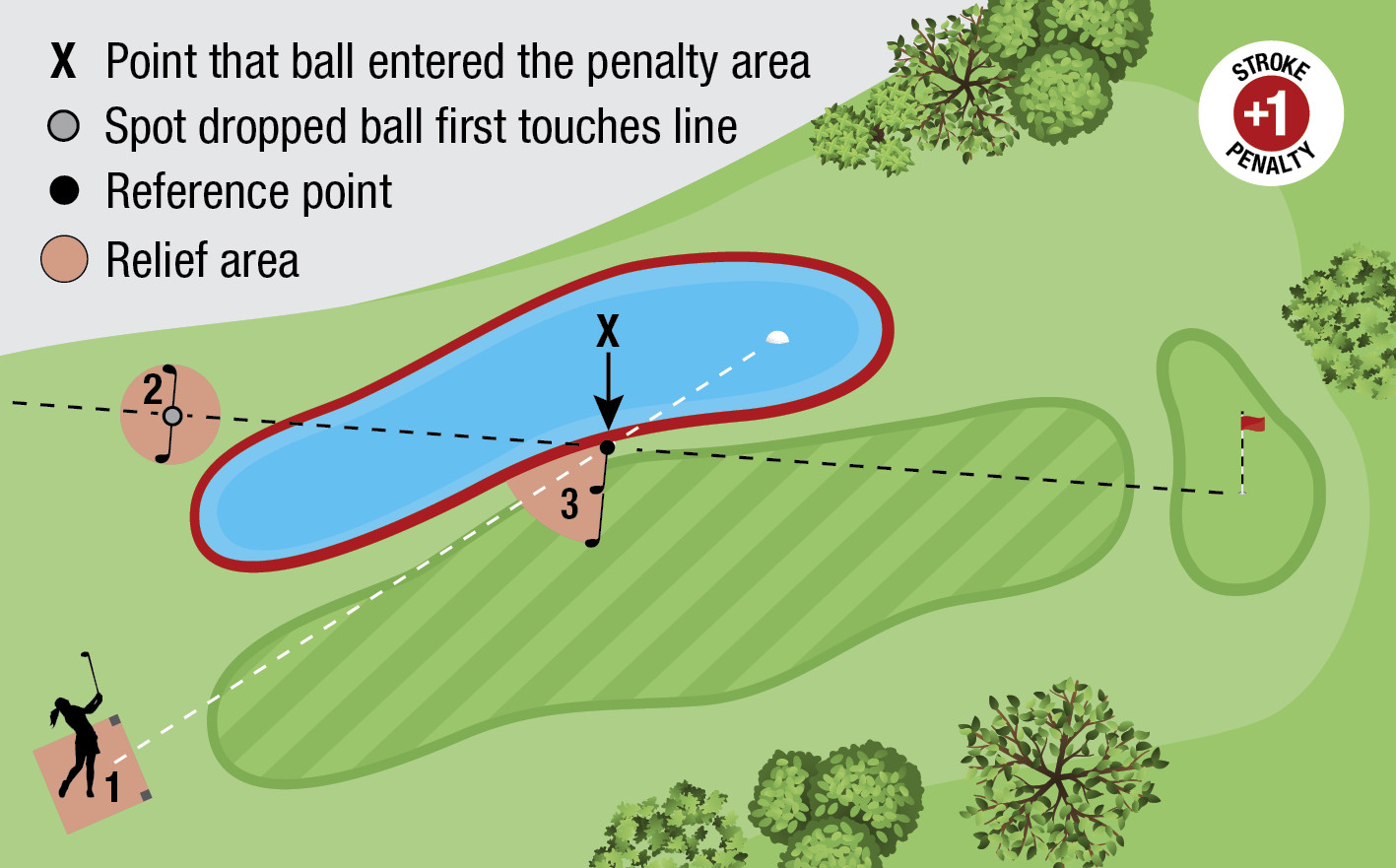
Lateral relief is the sideways drop, and it is the reason red stakes feel so much friendlier than yellow. Instead of retreating behind the trouble, you measure a relief area of two club lengths from your reference point and drop inside it, no nearer the hole. For a red penalty area the reference point is where the ball last crossed the edge, and for an unplayable ball it is the spot of the ball itself.
The measuring stick is defined precisely: The longest club in your bag other than your putter, which for almost everyone means the driver. You do not have to use the driver for the actual measurement, but two club lengths always means two driver lengths, roughly ninety inches. Lay the club on the ground twice if you want to be sure; in a competition it is worth the ten seconds.
Two details catch people out. First, the two club lengths are measured from where the ball crossed the line, not from where it finished up, and on a fast running ball those can be forty yards apart. Second, the relief area can never be nearer the hole than the reference point, even by an inch, so on a penalty area that angles towards the green the usable area can be a thin sliver. Drop from knee height inside the area, and if the ball rolls out, re-drop; after a second roll out you place it where it touched the ground.
White Stakes: Out of Bounds
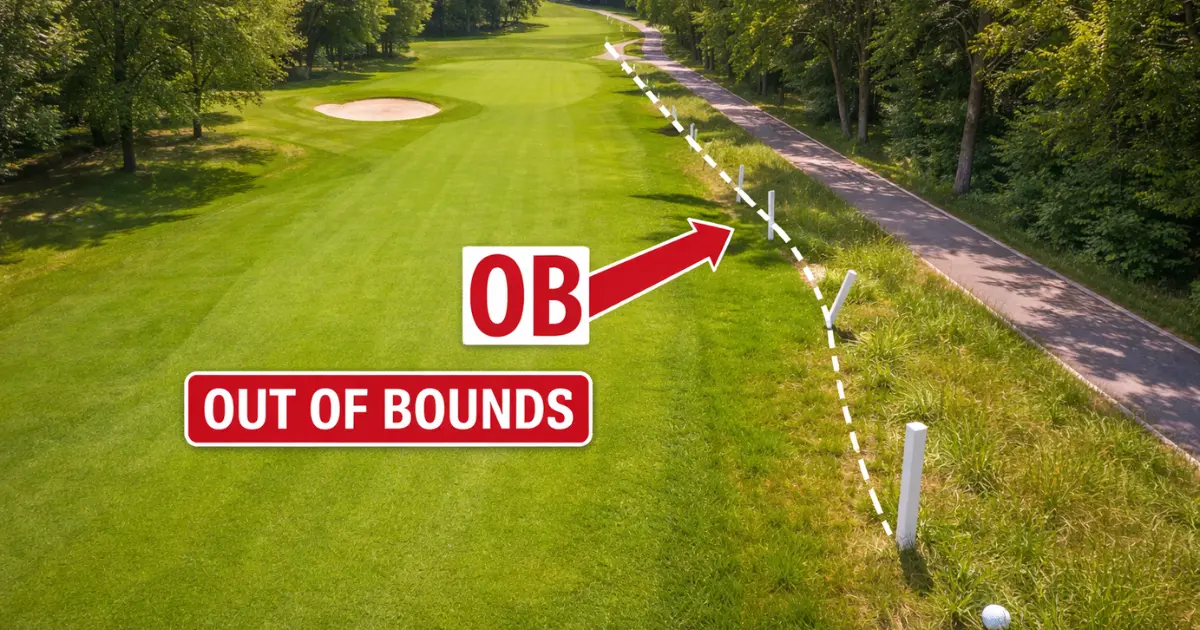
White stakes (or a boundary fence, wall or line) mark out of bounds, and this is the harshest penalty in golf: Stroke and distance, with no other option. You must return to where you played the previous shot and play again, adding one penalty stroke. Slice your tee shot over the fence and you are playing your third shot from the tee. There is no drop at the point it crossed, no two club lengths, no back on the line. So when in doubt, play a provisional, and declare to everyone that you are playing a provisional: It costs you nothing if the ball turns out to be safe, and it saves the long walk back if it is not.
When is a ball actually out?
The boundary line runs between the inside edges of the stakes at ground level, and a ball is only out of bounds when all of it lies beyond that line. If any part of the ball touches the course side of the line, it is in bounds and in play, even if the rest of it hangs over the fence. You are also allowed to stand out of bounds to play a ball that is in bounds.
Two more traps worth knowing. Boundary stakes are fixed objects, so unlike red and yellow stakes you get no free relief from them and you must not pull them out of the ground to clear your swing (that costs two strokes if you do not replace them before playing). And out of bounds is decided by the boundary of the course, not the hole, so a ball on the wrong fairway is usually still very much in play.
The two stroke local rule your club might use
Some clubs use Model Local Rule E-5 for general play. It gives you an alternative when a ball is lost outside a penalty area or goes out of bounds and you have not played a provisional. For two penalty strokes, you may drop in a large relief area extending towards the edge of the fairway. It can also be used in some club competitions, although it is not considered suitable for professional or elite amateur events. Always check whether the Committee has adopted it.
The Lost Ball
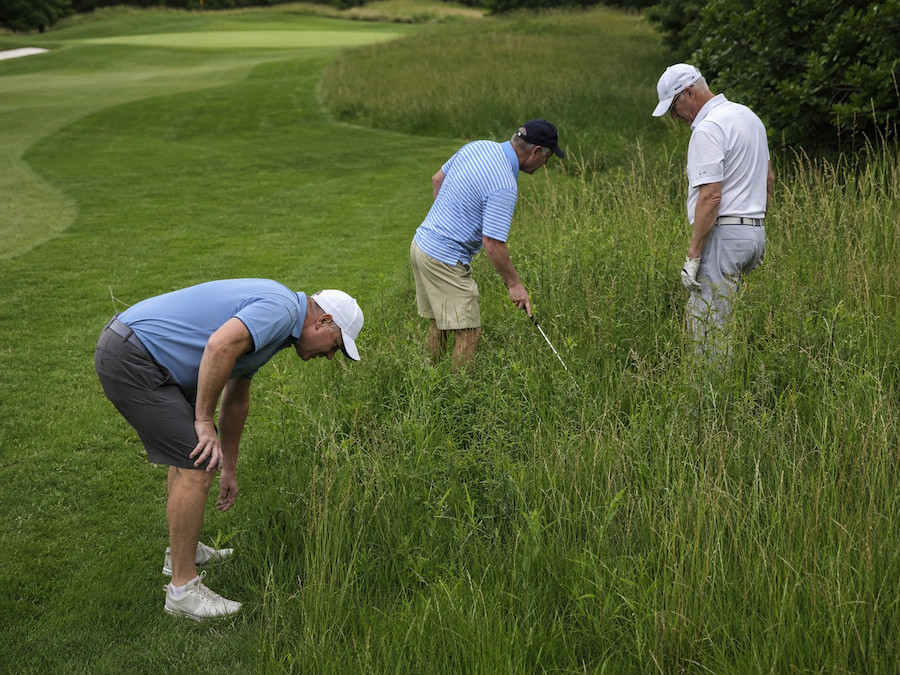

A lost ball costs the same as out of bounds: Stroke and distance. Add one penalty stroke and replay from the spot of the previous shot. Since 2019 you have three minutes to search, down from the old five, and the clock starts when you or your caddie begin looking. Find it at three minutes and one second and it is still a lost ball, even if it is sitting up nicely in the middle of the fairway.
The provisional ball, your best friend
Because the only remedy is going all the way back, the provisional ball exists to save you the walk of shame. If your ball might be lost outside a penalty area, or might be out of bounds, announce clearly that you are playing a provisional and hit another before you go forward. The announcement matters: Mumble nothing and simply drop another ball, and that second ball automatically becomes the ball in play under stroke and distance, even if you then find the original sitting perfectly.
- Original found in bounds within three minutes: You must abandon the provisional and play the original, no penalty.
- Original lost or out of bounds: The provisional becomes the ball in play, lying three off the tee.
- Do not play the provisional too far forward: You may continue playing it while you remain the same distance from the hole, or farther away, than the estimated position of the original. Once you play it from nearer the hole, it becomes the ball in play.
- Ball known to be in a penalty area: You cannot play a provisional for it; use the penalty area options from sections 1 and 3 instead.
Commonly misquoted: The fairway does not save you
There is no such thing as free relief for a ball lost in bounds, and no free drop simply because the penalty area is the most likely place your ball went. It must be known or virtually certain that the ball finished there. You do not necessarily have to see it enter, but the available evidence must make any other outcome extremely unlikely. Picture a pond surrounded by tightly mown fairway with nowhere for a ball to hide: Your shot flew straight at it and never reappeared, so even without seeing the splash you can treat it as being in the penalty area. But if there is thick rough beside the water where the ball could just as easily be sitting, probably in the pond is not enough, and a ball you cannot find is simply lost.
Other Penalties Golfers Get Wrong
Beyond stakes and lost balls, a handful of situations produce more bad rulings in friendly golf than everything else combined. Here are the ones worth knowing cold.
The unplayable ball: Your get out anywhere
You may declare your ball unplayable anywhere except a penalty area, and you alone decide. For one penalty stroke you can replay from the previous spot, drop within two club lengths no nearer the hole, or drop back on the line keeping the point of the ball between you and the flag. Against a tree root or under a bush, taking your medicine early is nearly always cheaper than the hack out that goes nowhere.
Accidentally moving your ball
On the putting green, or while searching for your ball: No penalty, just replace it. Anywhere else, if you cause your ball to move it is one penalty stroke and the ball must be replaced. A ball moved by wind, water or gravity alone is played from its new spot with no penalty, unless it was already replaced on the green, in which case it goes back.
Playing a wrong ball
Hit someone else's ball, or an abandoned ball, and it is two penalty strokes in stroke play (loss of hole in match play), and you must then correct the mistake by playing your own ball. The strokes with the wrong ball do not count. This is why marking your ball distinctively matters: Identical balls found together in the rough with no way to tell them apart can both be lost.
Penalties that no longer exist
Several famous penalties were abolished in 2019, and they still get wrongly imposed today. There is no penalty for a double hit (it counts as one stroke), for a ball that accidentally strikes you or your equipment, for a ball deflected off the flagstick left in the hole while putting on the green, or for accidentally moving your ball marker. If someone tries to add strokes for any of these, the rulebook is on your side.
Dropping wrongly
Drops are made from knee height, not shoulder height, and the ball must land in and stay within the relief area. Drop from the wrong height and correct the mistake before playing: There is no penalty. If you play the incorrectly dropped ball from within the correct relief area, the penalty is one stroke. If you play from outside the relief area, the general penalty of two strokes applies. If a correctly dropped ball rolls out of the relief area, you re-drop, and after a second try you place it where it touched the ground.
Divots, molehills, nests and droppings
Finding someone else's divot hole in the middle of the fairway feels like the greatest injustice in golf, but the rulebook is blunt: There is no free relief from a divot. Play it as it lies or declare it unplayable for a stroke. Animal damage is a different story. A molehill, or any hole made by an animal, is an abnormal course condition, so if your ball lies in or on it, or it interferes with your stance or intended swing, you get free relief: Find the nearest point of complete relief and drop within one club length of it, no nearer the hole. Animal droppings are treated as loose impediments, so you can pick them off and around your ball without penalty, just take care, because if you move the ball while doing so anywhere other than the green it costs one stroke. And if playing your shot would damage a bird's nest, the rules do not force you to choose between the bird and your score: Free relief is available there too.
Quick reference: What each situation costs
| Situation | Penalty | Your options |
|---|---|---|
| Yellow penalty area | 1 stroke | Play it, stroke and distance, or back on the line |
| Red penalty area | 1 stroke | All yellow options, plus two club lengths sideways |
| Out of bounds (white) | 1 stroke | Stroke and distance only (unless the E-5 local rule applies) |
| Lost ball | 1 stroke | Stroke and distance only; three minute search |
| Unplayable ball | 1 stroke | Replay, two club lengths, or back on the line |
| Wrong ball | 2 strokes | Correct the error, then play on with your own ball |
| Ball moved (general area) | 1 stroke | Replace the ball; free on the green or while searching |
| Ball in a divot | None | No relief; play it as it lies or take the unplayable option |
| Molehill or animal hole | None | Free relief within one club length of the nearest point of relief |

Good course management keeps you out of penalties
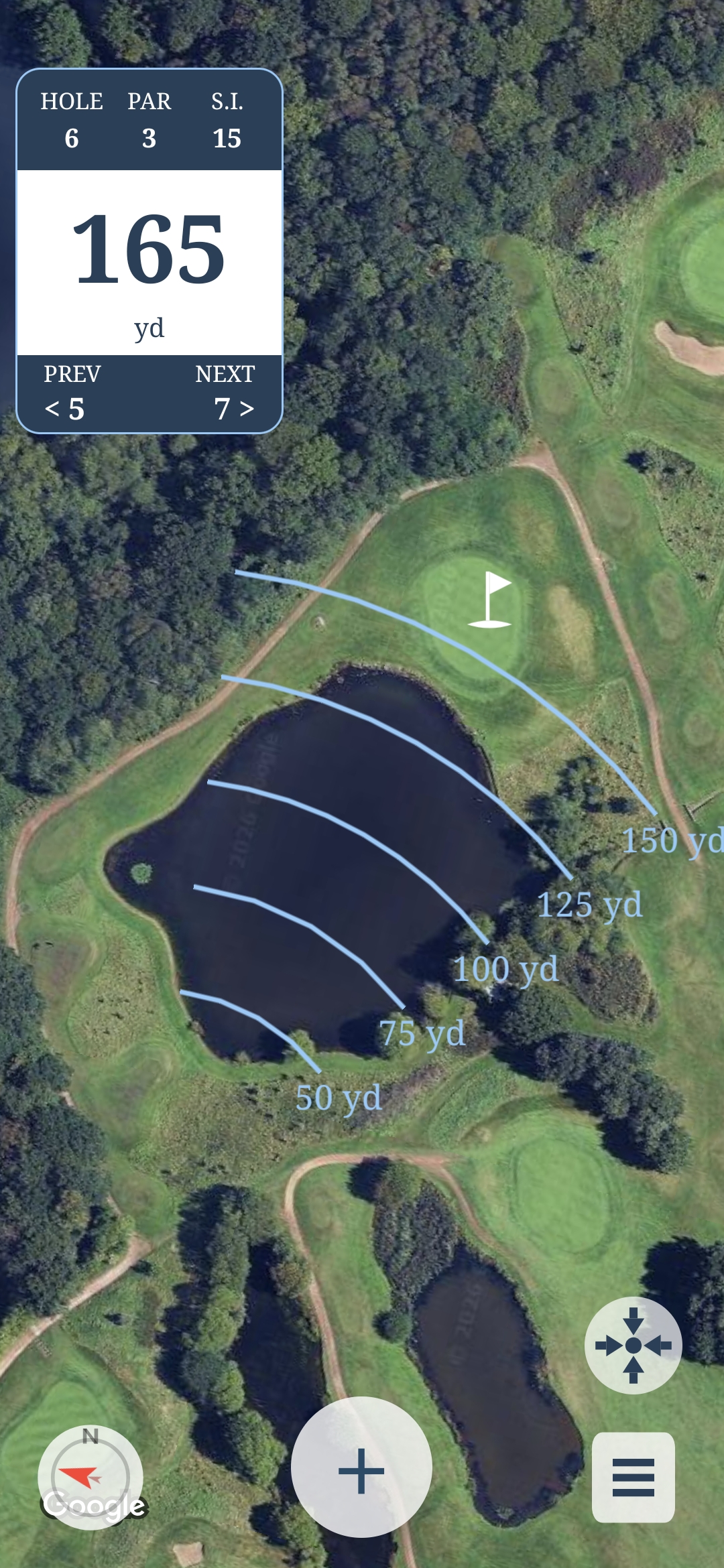
The cheapest penalty stroke is the one you never take. Almost every ball that finds water, sails out of bounds or vanishes in the rough comes from the same root cause: A club choice made on guesswork. The player did not know how far the trouble really was, so they took on a carry they could not make, or blazed a driver through a fairway that ran out.
This is where Shark Club helps. The app shows live GPS distances between you and the hazards ahead: How far to reach the water, how far to carry it, and how far to the front, middle and back of the green. If you know that a pond begins at 210 yards and requires 240 yards to carry, you can make a sensible decision based on your normal club distances. For many golfers, laying up short will be the better percentage play.
Shark Club runs on iPhone, Apple Watch, Android and Wear OS, with GPS distances, scorecards, Stableford scoring and handicap tracking. Want more reading? Try All About Bunkers or Types of Golf Courses Explained. For help getting set up, visit the Shark Club Support & FAQ.
Share this article
Enjoyed the read? Pass it on to your golf friends.