
Golf Handicaps Explained
A handicap is the thing that lets a 24 handicapper and a scratch golfer play a fair match on a Saturday morning. It’s also one of those things golfers use all the time without really knowing how it works. Here is how the World Handicap System works, what the difference is between your Handicap Index, Course Handicap and Playing Handicap, and what has changed recently.
Why have a handicap?
No other mainstream sport lets a beginner and an expert compete on level terms, yet golf has done it for well over a century. The handicap is a number that represents your ability, and it is used to give you strokes so that your net score (your actual score minus your handicap) can be compared with anyone else's. A 20 handicapper who shoots 92 has played to a net 72, and has beaten a 6 handicapper who shoots 80 for a net 74.
That is the competition argument, and it is the reason handicaps exist. But there are three others that matter just as much to the everyday golfer.
- It measures progress. Your score on any given day depends on the course, the tees, the wind and your luck. A handicap smooths all of that out into one number that moves when you genuinely get better, or worse.
- It sets a realistic target. Knowing that a par is a good score on most holes, and that a bogey is your "par" on the hardest ones, changes how you think about the round. Most golfers play better once they stop chasing the card's par.
- It opens doors. Many clubs require a handicap for competitions, open days and some visitor tee times. Golf societies use it to run fair events, and most golf trips involve at least one argument that a handicap settles.
What is the World Handicap System?
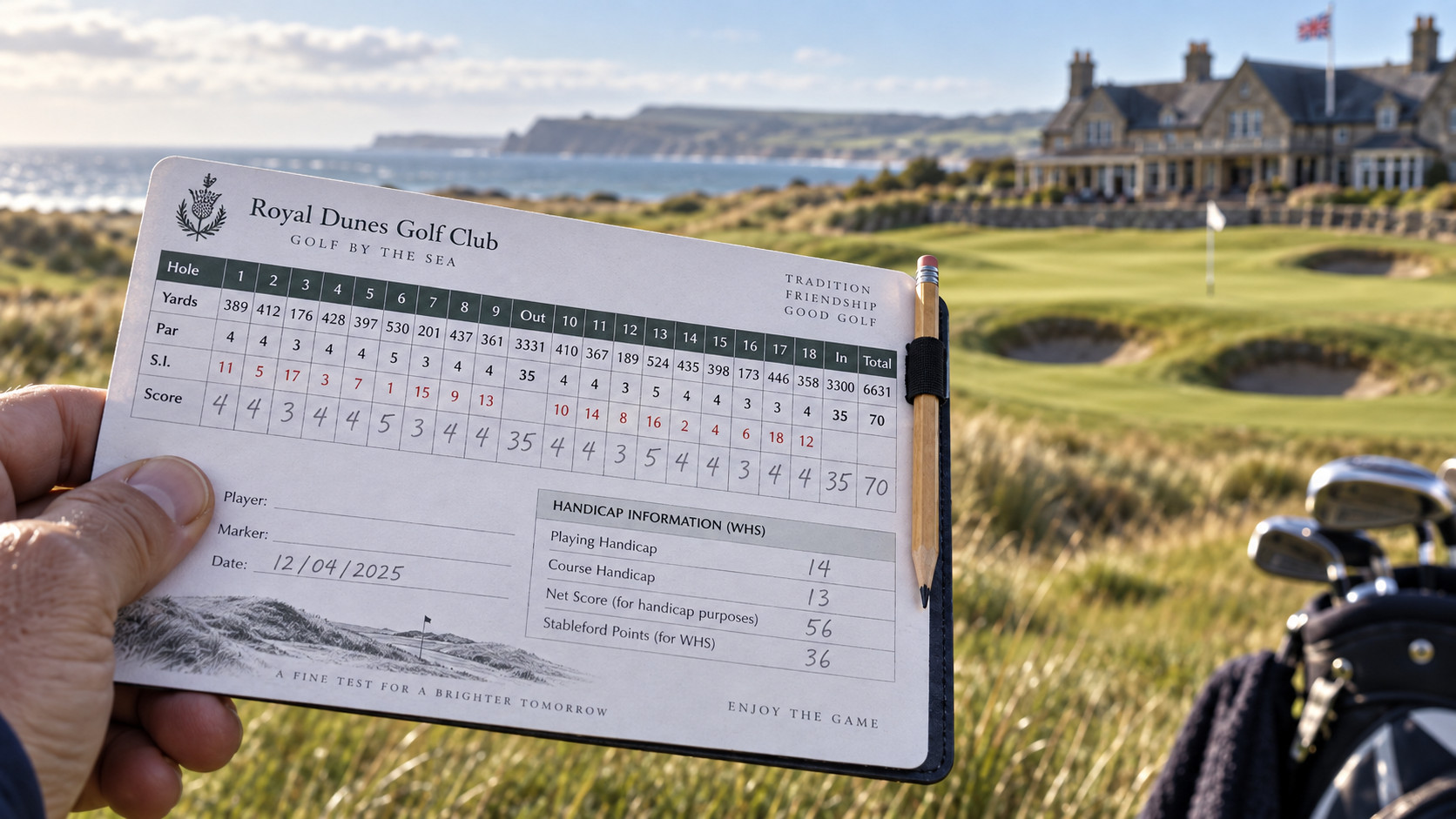
Until 2020, golf had six different handicap systems. The USGA system in America, CONGU in Great Britain and Ireland, the EGA system across continental Europe, and separate systems in Australia, South Africa and Argentina all produced a number called a handicap, but they were calculated differently and did not transfer cleanly between countries. A 12 handicap in Surrey was not the same 12 as one in Florida.
The World Handicap System (WHS), developed by the R&A and the USGA, replaced all six with a single set of Rules of Handicapping. It launched in the United States in January 2020 and in Great Britain and Ireland in November 2020, with most other countries adopting it during 2020 and 2021. Today one Handicap Index works at any rated course in the world.
What the WHS changed
- Averaging, not incremental adjustment. The old CONGU system nudged your handicap up by 0.1 for a bad round and down by a set amount for a good one. The WHS takes an average of your best recent rounds instead, so a single freak round has less effect.
- Slope and Course Rating everywhere. The USGA's Slope system, which measures how much harder a course is for a bogey golfer than a scratch golfer, became the worldwide standard. Every set of tees on every rated course now has both numbers.
- A maximum of 54.0. The upper limit was raised to 54.0 for men and women alike, so complete beginners can hold a handicap from their first few rounds.
- Daily updates. Your Handicap Index is recalculated overnight every time a score is submitted, rather than at the end of a review period.
- General play scores count. In Great Britain and Ireland, where previously only competition scores counted, a casual round now feeds your handicap as long as you sign it in on the national app before you tee off and a playing partner attests the score afterwards.
How your Handicap Index is worked out
Your Handicap Index is the headline number, the one that appears on your club app and follows you to any course. It is calculated to one decimal place and represents your demonstrated ability on a course of standard difficulty. The calculation has three steps.
Step 1: Each round becomes a Score Differential
The WHS does not average your raw scores, because an 85 on a brutal championship course is a better round than an 85 on a short, flat members' course. Every acceptable round is instead converted into a Score Differential, which strips out the difficulty of the course you played.
Adjusted Gross Score is your score after any hole is capped at net double bogey (more on that in Section 6). PCC is the Playing Conditions Calculation, an automatic adjustment made when the whole field scored unusually well or badly that day, typically because of wind or weather. It ranges from −1.0 to +3.0 and on most days it is zero. If you shoot an adjusted 88 on a course with a Course Rating of 71.2 and a Slope of 125 in normal conditions, your differential is (113 ÷ 125) × (88 − 71.2) = 15.2.
Step 2: Take the best 8 of your last 20
Your Handicap Index is the average of the best 8 Score Differentials from your most recent 20 rounds. The twelve worst are ignored entirely, which is why the WHS measures your potential rather than your average. When you submit a new score, the oldest of the 20 drops out and the calculation runs again. If you have fewer than 20 rounds on record, a smaller number of differentials is used, with an adjustment applied while the sample is very small.
| Rounds on record | Differentials used | Adjustment |
|---|---|---|
| 3 | Lowest 1 | −2.0 |
| 4 | Lowest 1 | −1.0 |
| 5 | Lowest 1 | None |
| 6 | Average of lowest 2 | −1.0 |
| 7 or 8 | Average of lowest 2 | None |
| 9 to 11 | Average of lowest 3 | None |
| 12 to 14 | Average of lowest 4 | None |
| 15 or 16 | Average of lowest 5 | None |
| 17 or 18 | Average of lowest 6 | None |
| 19 | Average of lowest 7 | None |
| 20 or more | Average of lowest 8 | None |
You need 54 holes of acceptable scores to get a first Handicap Index, in any combination of 9 and 18 hole rounds, so three 18 hole rounds or six 9 hole rounds will do it.
Step 3: Safeguards are applied
The system keeps a record of your Low Handicap Index, the lowest Index you have held in the previous 365 days, and uses it to stop your handicap running away upwards during a bad patch.
- Soft cap. Once your calculated Index would be more than 3.0 strokes above your Low Handicap Index, any further increase is halved.
- Hard cap. Your Index can never rise more than 5.0 strokes above your Low Handicap Index, however badly you play.
- Exceptional score reduction. Play a round with a differential at least 7.0 strokes better than your Index and every one of your 20 differentials is reduced by 1.0. At least 10.0 strokes better and the reduction is 2.0. It is the WHS's way of reacting quickly when a golfer suddenly finds form.
Course Rating and Slope Rating
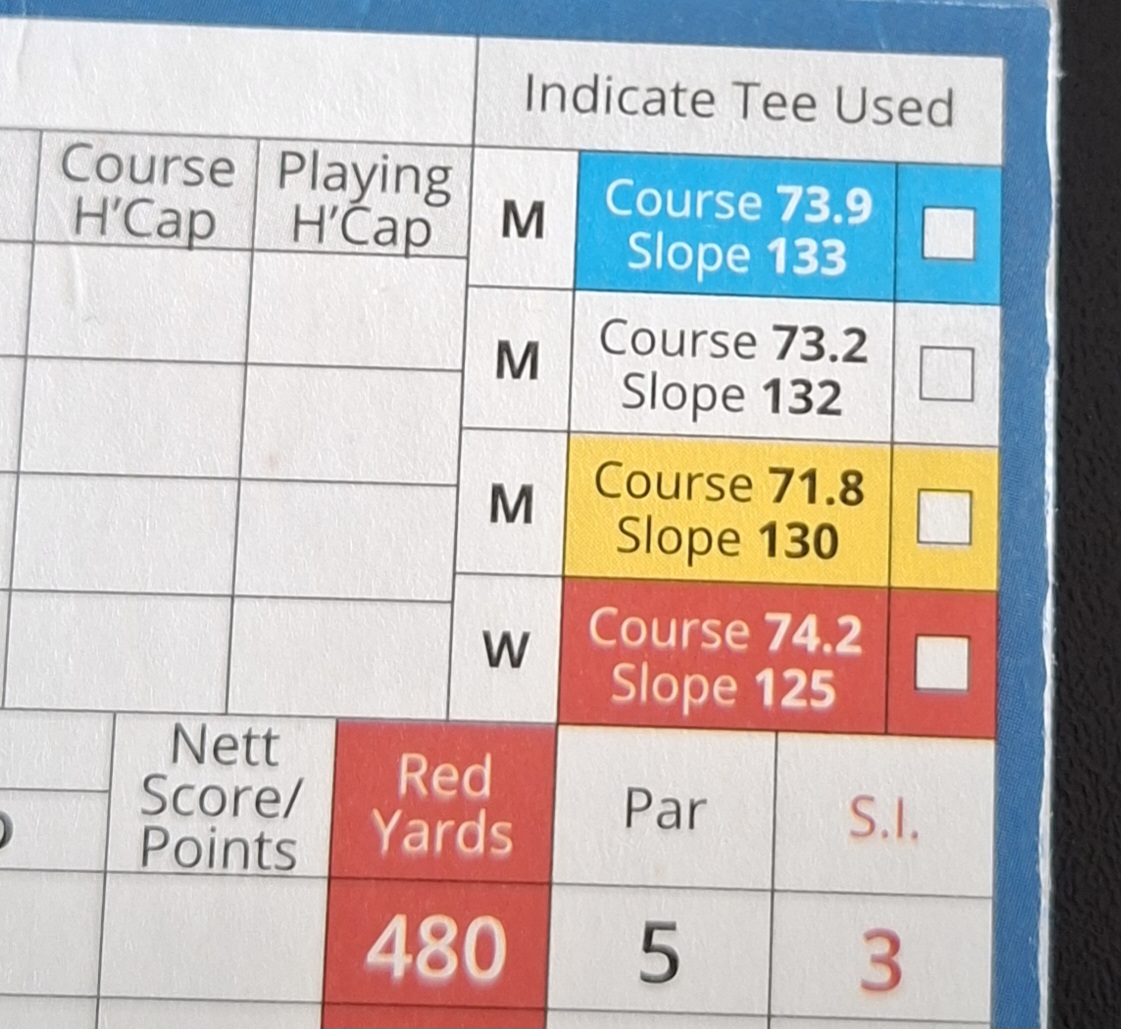

Both numbers are set by a team of trained raters who walk the course measuring length, obstacles, green sizes, rough, water, out of bounds and the psychology of each shot. They rate every set of tees separately, and they rate them twice: Once for a scratch golfer and once for a bogey golfer.
Course Rating
Course Rating is the score a scratch golfer is expected to shoot from those tees on a normal day, to one decimal place. It is usually close to par but not the same as par. A 6,900 yard par 72 might carry a Course Rating of 74.1, meaning a scratch player would expect to be over par, while a short par 70 might be rated 67.8. The gap between Course Rating and par is important later, because it feeds directly into your Course Handicap.
Slope Rating
Slope Rating measures how much harder the course is for a bogey golfer (roughly a 20 handicap man or a 24 handicap woman) than for a scratch golfer. It runs from 55 to 155, and 113 is the neutral value that represents a course of standard difficulty. A high Slope does not mean a course is hard for everyone. It means the trouble bites the higher handicapper disproportionately: Forced carries, thick rough, out of bounds and water that a scratch player flies past but a 20 handicapper visits regularly. That is why Slope, not Course Rating, drives how many extra strokes you receive.
Where does 113 come from?
When the USGA built the Slope system in the 1980s it found that on an average course the bogey golfer's expected score was about 113 percent further from the Course Rating than the scratch golfer's. That average became the reference point. Whenever you see 113 in a WHS formula, it is simply converting between your ability on a standard course and your ability on this one.
Handicap Index vs Course Handicap vs Playing Handicap
This is probably the part we hear golfers getting mixed up about most, and it helps to think of the three numbers as a chain. Your Handicap Index is your portable ability. Your Course Handicap adapts it to the tees you are standing on. Your Playing Handicap adapts it again for the format you are playing. Each one is derived from the one before.
Handicap Index
Your ability on a course of standard difficulty, to one decimal place, from the best 8 of your last 20 differentials. Examples: 14.3, 3.7, 28.9.
Course Handicap
Your Index converted for the Slope, Course Rating and par of the tees you are playing, rounded to a whole number. It tells you how many strokes you get against par on this course today.
Playing Handicap
Your Course Handicap multiplied by a handicap allowance for the format, for example 95 percent in an individual stroke play competition. This is the number you actually write on the card.
Course Handicap
The first half scales your Index up on a high Slope course and down on a low Slope one. The second half adds strokes when the Course Rating is above par, because even a scratch golfer is expected to be over par there, and takes them away when the rating is below par. The result is rounded to the nearest whole number, so Course Handicaps are always integers. Every club displays a Course Handicap table by the first tee, and the Shark Club app does the sum for you when you select your tees.
Playing Handicap
The allowance exists because research on millions of scores shows that higher handicappers have more variance, so in a big field they win more than their share of medals when handicaps are applied in full. Reducing everyone's Course Handicap by a percentage evens that out. The standard WHS allowances are:
| Format | Allowance | Notes |
|---|---|---|
| Individual stroke play, Stableford, par/bogey | 95% | The default for club medals and Stableford competitions |
| Individual match play | 100% | The lower player plays off scratch, the higher receives the difference |
| Four-ball stroke play or Stableford | 85% | Each partner's own score, best ball counts |
| Four-ball match play | 90% | Strokes given relative to the lowest player in the group |
| Foursomes (alternate shot) | 50% of combined | Add both partners' Course Handicaps and halve |
| Greensomes | 60% low + 40% high | Weighted towards the better player |
| Scramble (4 players) | 25 / 20 / 15 / 10% | Recommended allowances, from lowest to highest handicap |
Two things worth knowing. First, the allowance is applied to your unrounded Course Handicap, and the result is rounded once at the end. A Course Handicap that works out at 15.4 is displayed as 15, but in a medal it becomes 15.4 × 0.95 = 14.6, so a Playing Handicap of 15, whereas 15.0 × 0.95 = 14.25 gives a 14. Working from the rounded figure can leave you a stroke out, which is why club software and the Shark Club app both keep the decimals until the last step. Second, in casual golf with your mates the allowance is entirely optional. Most friendly fourballs just play off full Course Handicap and nobody minds.
A worked example: One golfer, three courses
Take a golfer with a Handicap Index of 14.3 and follow the chain across three sets of tees in an individual Stableford competition at the standard 95 percent allowance.
| Course | Slope | Rating / Par | Course Handicap calculation | Course Hcp | Playing Hcp (95%) |
|---|---|---|---|---|---|
| Members' parkland, yellow tees | 125 | 71.2 / 72 | 14.3 × 125 ÷ 113 + (71.2 − 72) = 15.8 − 0.8 = 15.0 | 15 | 14 |
| Championship links, white tees | 138 | 73.6 / 72 | 14.3 × 138 ÷ 113 + (73.6 − 72) = 17.5 + 1.6 = 19.1 | 19 | 18 |
| Short heathland, forward tees | 108 | 68.9 / 71 | 14.3 × 10⁸ ÷ 113 + (68.9 − 71) = 13.7 − 2.1 = 11.6 | 12 | 11 |
The same golfer receives 11 strokes on one course and 18 on another, from a single Handicap Index that has not changed. That spread is the whole point of the system. It is also why the old question "what do you play off?" no longer has a single answer.
Handicap strokes, Stroke Index and Stableford
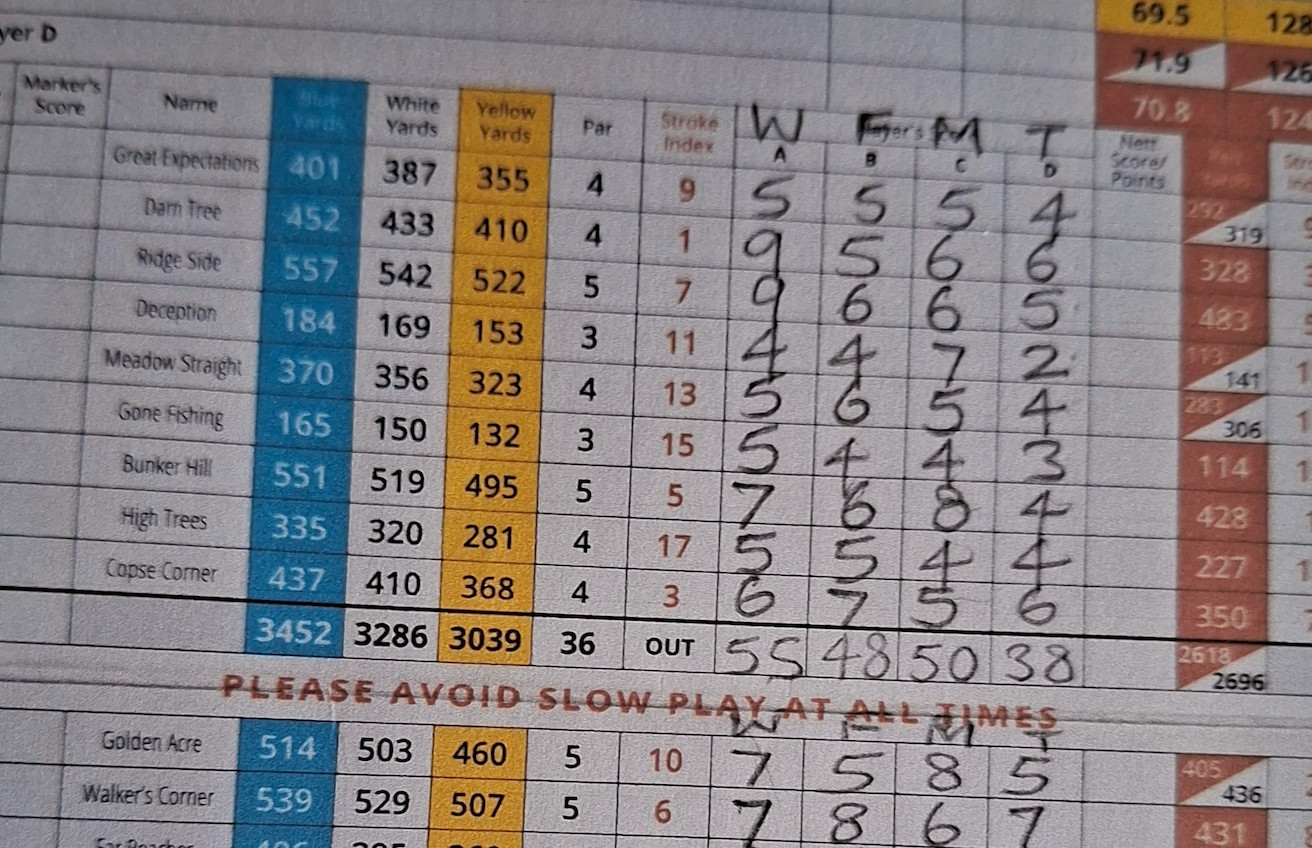
Once you know your Playing Handicap, the scorecard tells you where to use it. Every hole carries a Stroke Index from 1 to 18, with 1 being the hole where a stroke is judged to help most and 18 the least. Clubs set them so that odd numbers fall on one nine and even numbers on the other, which keeps a match fair whichever nine you start on.
- Playing Handicap of 18 or fewer: You receive one stroke on every hole whose Stroke Index is less than or equal to your handicap. A 12 gets a shot on Stroke Index 1 to 12.
- Playing Handicap above 18: One stroke on every hole, then a second stroke on Stroke Index 1 onwards. A 24 gets two shots on Stroke Index 1 to 6 and one shot everywhere else. A 40 gets two shots everywhere plus a third on Stroke Index 1 to 4.
- Plus handicaps: Better than scratch golfers give strokes back, starting at Stroke Index 18 and working downwards. A +2 adds a stroke to their score on Stroke Index 18 and 17.
Your net score on a hole is your gross score minus the strokes you receive there. A 5 on a par 4 where you get a shot is a net 4, a net par.
Stableford points
Stableford is the most popular club format in the UK and Ireland, and it is built entirely around net scores. You earn points on each hole based on how your net score compares to par, and the hole is over the moment you can no longer score a point, which keeps the round moving.
| Net score on the hole | Points |
|---|---|
| Net double bogey or worse | 0 |
| Net bogey | 1 |
| Net par | 2 |
| Net birdie | 3 |
| Net eagle | 4 |
| Net albatross | 5 |
Playing exactly to your handicap earns 36 points, two per hole. Anything above 36 is a good day and will probably bring your Index down. Because Stableford points are already net, your points total is a direct read of how you played against your handicap, and the app can show it hole by hole without you doing any arithmetic.
Adjusted Gross Score and net double bogey
Golfers are often surprised when the score that goes into their handicap record is lower than the score they actually shot. The reason is net double bogey, the maximum any single hole can count for handicap purposes.
If you get one shot on a par 4, your net double bogey is 7. Make a 9 and it still goes down as a 7 in your Adjusted Gross Score, the total that feeds the Score Differential formula. The cap stops one disaster hole wrecking a handicap that otherwise reflects your game, and it means a blow-up hole in a Stableford, where you would have picked up anyway, is treated identically to one in a medal.
It also deals with those awkward rounds where you pick up or don't finish all 18.
- Picked up: If you started the hole but did not hole out, record your most likely score, capped at net double bogey. In a Stableford this is simply a zero point hole.
- Hole not started, 10 to 17 holes played: Since the 2024 revision, your Score Differential for the holes played is combined with an expected differential for the holes you missed, based on your Handicap Index. Before 2024 the missing holes were filled in with net par.
- Fewer than 10 holes played: If you completed at least 9 holes, the round is submitted as a 9 hole score. Fewer than 9 and it is not acceptable for handicap purposes.
- 9 hole rounds: Also since 2024, a 9 hole score is converted straight into an 18 hole differential using your expected score for the other nine, so it counts immediately. Under the original WHS you had to wait for a second 9 hole score to pair it with.
What counts as an acceptable score?
A score is acceptable for handicap purposes when it is played by the Rules of Golf, on a course with a current Course and Slope Rating, over at least 9 holes, in an authorised format, and with a marker or playing partner to attest it. Solo rounds do not count anywhere in the world. Rounds where you have used preferred lies under a local rule are fine, and rounds played abroad count as long as the course is rated and the score is submitted to your home club or app.
Recent changes to the World Handicap System

The WHS is reviewed on a four year cycle. The first full revision took effect in 2024, a set of national changes to Playing Handicap allowances arrived in parts of the British Isles in 2026, and the next worldwide revision is scheduled for 2028.
The 2024 revision
Effective from 1 January 2024 in the United States and most other countries, and from 1 April 2024 in Great Britain and Ireland, the revision was based on more than 100 million scores submitted during the system's first three years. For most club golfers, the changes that actually mattered were:
- 9 hole scores count straight away. A 9 hole score is now combined with your expected differential for the other nine to produce an 18 hole Score Differential the same day. Previously two 9 hole scores had to wait to be paired up, which put many golfers off submitting them at all.
- Expected score replaces net par. When you play 10 to 17 holes, the holes you did not play are now filled using your expected score based on your Handicap Index, rather than net par. Expected score does not depend on the course's Stroke Index, so it is more consistent from course to course.
- Shorter courses can be rated. The minimum length for a Course and Slope Rating was halved to 1,500 yards for 18 holes and 750 yards for 9 holes. Par 3 and short courses that were previously ineligible can now issue acceptable scores, which brings a lot of beginner friendly golf into the system.
- A more responsive Playing Conditions Calculation. The PCC was tuned to trigger more readily when a field scores unusually well or badly, after data showed the original version adjusted on too few days.
- Better handicap review tools. Clubs were given reporting that flags golfers whose Index looks out of line with their recent results, to support the annual handicap review.
2026: Playing Handicap allowances become a club decision, but not in England
The 95 percent and 85 percent allowances described in Section 4 have long been mandatory in GB&I competitions. After a trial in 2025, Golf Ireland, Scottish Golf and Wales Golf moved from 1 April 2026 to give clubs discretion over the figure within a set range:
| Format | Previous mandatory allowance | Club options from April 2026 |
|---|---|---|
| Individual stroke play and Stableford | 95% | 85%, 90%, 95% or 100% |
| Four-ball stroke play and Stableford | 85% | 75%, 80%, 85% or 90% |
The change came from clubs asking for tools to deal with the perception that lower handicappers rarely win big field competitions. Early feedback from the Irish trial suggested most clubs left the allowances as they were, so in practice many golfers will see no difference, but it is worth checking the competition terms before you write your Playing Handicap on the card.
England Golf chose not to follow. In December 2025 it announced that it would postpone any change to Playing Handicap allowances until at least 2028, to line up with the next worldwide WHS review, and would spend the intervening time evaluating measures already in place to improve competition equity. So an English golfer playing in Scotland or Wales may find a club competition running at 90 percent while their home club stays at 95.
What to expect in 2028
The R&A and USGA have not published the 2028 changes, but the areas under review are well known: How allowances should work, whether the PCC should be more transparent, how quickly a rapidly improving golfer's Index should fall, and how to treat scores from simulators and shorter formats. We will update this article when the next revision is announced.
Common handicap myths
"My handicap is my average score over par"
Not quite. This is probably the most common misunderstanding about handicaps. Your Index uses only your best 8 of 20, so it represents how well you play on a good day. The average golfer plays to their handicap roughly one round in four or five. Shooting a few strokes over your Course Handicap most weeks is completely normal and does not mean your handicap is wrong.
"An 18 handicapper shoots 90"
Only if par is 72, the Course Rating is 72.0 and the Slope is 113, which almost never happens. An 18.0 Index on a championship course with a Slope of 140 and a rating of 74 is a Course Handicap of 24, so playing to it means a 96. On an easy course it might be a 15 and an 87. Always convert to a Course Handicap before judging a score.
"Handicaps only go down"
They go up as easily as they come down. Every new score pushes the oldest one out of your 20, and if one of your best 8 leaves the window your Index rises. The soft and hard caps limit how far it can climb in a year, but a golfer who stops practising will see it drift upwards within a season.
"A high Slope means a hard course"
A high Slope means a course that is disproportionately hard for the bogey golfer. Course Rating is the measure of outright difficulty. A long, open course with no hazards can have a high rating and a modest Slope, while a short course with water on every hole can be the other way around.
"I can pick which rounds I submit"
You should not. The Rules of Handicapping expect every acceptable round to be submitted, good or bad, and in GB&I a general play round must be signed in before you play, not after you see the score. Golf has two words for the people who bend this. A sandbagger deliberately inflates their handicap by submitting bad rounds and quietly forgetting good ones, and a bandit is the golfer who turns up to the open day with a handicap nobody believes and walks off with the prize. Sandbagging is the oldest trick in club golf, and it is exactly what the annual handicap review, penalty scores for unreturned rounds and the Low Handicap Index caps are designed to catch. The opposite sin is the vanity handicap, kept artificially low by only ever submitting your best rounds, which costs you strokes in every competition you enter.
"Playing off the forward tees is cheating"
Not under the WHS. Every set of rated tees has its own Course Rating and Slope, so your Course Handicap adjusts automatically. Playing the forward tees gives you fewer strokes, not an easier target, and the score you post is rated accordingly. The system was designed so that golfers can play the tees that suit them without any effect on the fairness of their handicap.
Handicap FAQ
How many rounds do I need to get a handicap?
54 holes of acceptable scores, in any combination of 9 and 18 hole rounds. Three 18 hole rounds or six 9 hole rounds will do it, and your first Handicap Index appears the day after the last score is submitted.
What is the maximum golf handicap?
The maximum Handicap Index is 54.0 for both men and women. Your Course Handicap can be higher than 54 on a high Slope course, because the conversion scales the Index up.
Why is my Course Handicap different at every course?
Your Index measures your game on a course of standard difficulty. The Course Handicap converts it using the Slope Rating, Course Rating and par of the exact tees you are playing, so harder tees give you more strokes and easier tees fewer. See the worked example in Section 4.
What is net double bogey?
The maximum score you can record on any hole for handicap purposes: Par plus two plus any handicap strokes you receive on that hole. In Stableford it is the score that earns zero points.
Can my handicap go up as well as down?
Yes. It is recalculated every time a score is added, using the best 8 of your most recent 20, so it rises when good rounds drop out of the window. The soft cap halves any increase beyond 3.0 above your Low Handicap Index and the hard cap stops it at 5.0 above.
Do 9 hole rounds count?
Yes, and since the 2024 revision they count immediately. Each 9 hole score is combined with your expected score for the other nine to create an 18 hole Score Differential the same day.
Does a casual round with friends count?
In the United States and Canada, yes, as long as you played by the Rules with a marker and post the score. In Great Britain and Ireland it counts if you signed it in as a general play round on the national app before you teed off and a playing partner attests the score. In most of continental Europe casual rounds do not count unless your federation runs a registered extra day score scheme.
What does "playing to your handicap" mean?
Shooting a net score equal to the Course Rating, or 36 points in a Stableford. Because your Index is based on your best rounds, most golfers do this only every four or five rounds. Beating it by a couple of shots is a genuinely good day.
What is a plus handicap?
A Handicap Index better than scratch, written as +1.5 or +3.0. Plus handicappers give strokes back rather than receiving them, starting at Stroke Index 18. Elite amateurs are typically somewhere between +2 and +6.

Track your handicap with Shark Club
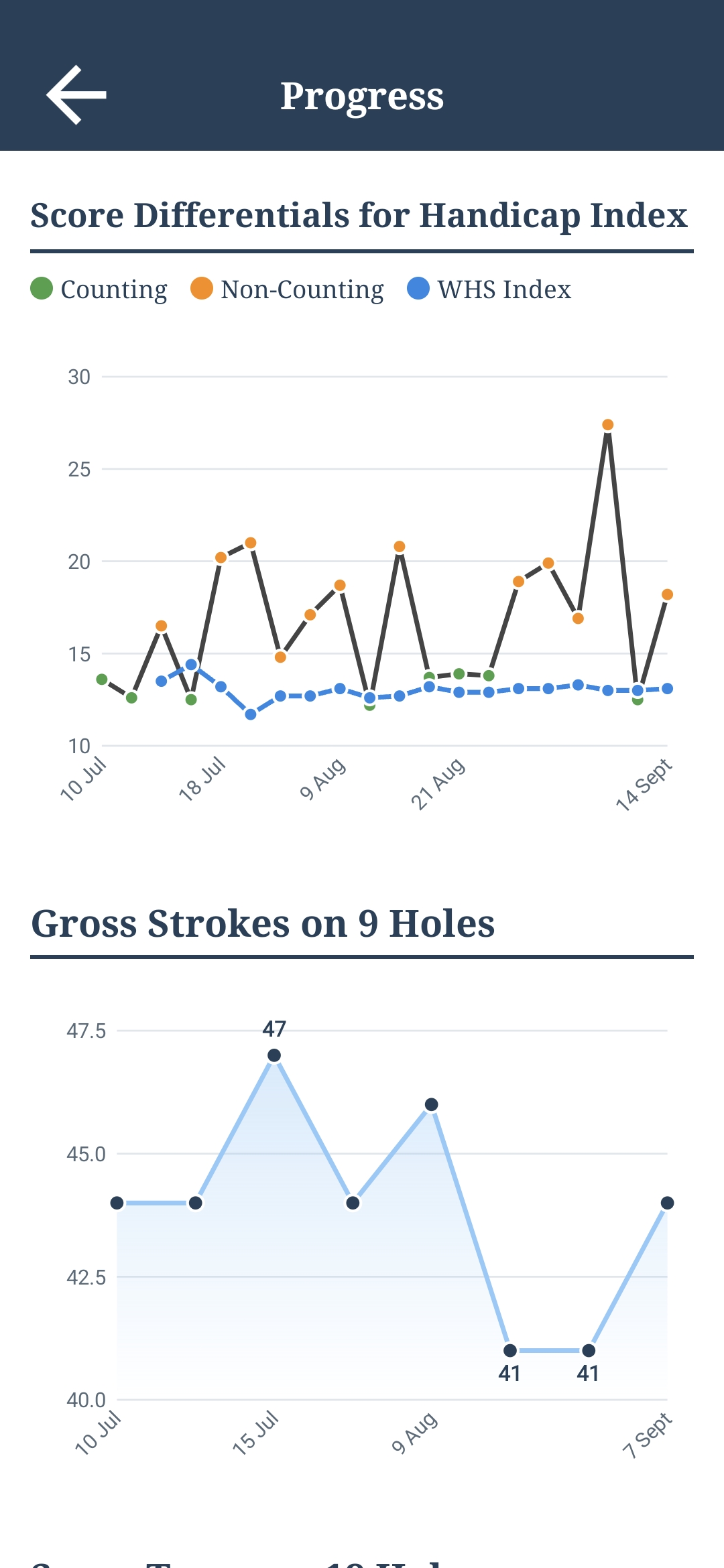
Everything in this article is arithmetic, and arithmetic is what apps are for. Shark Club follows the World Handicap System rules: It records your score hole by hole, applies net double bogey automatically, converts each round into a Score Differential using the Course Rating and Slope of the tees you played, and keeps a running Handicap Index from your best 8 of your last 20. If you have fewer than 20 rounds it uses the smaller sample rules from Section 2 until you get there.
On the course it shows your Stableford points as you go, so you always know where you stand against your handicap, alongside GPS distances to the front, middle and back of the green and to every hazard in between. Playing a new course? Pick the tees and the app works out your Course Handicap, or look the course up in our course directory for its ratings, yardages and maps before you go.
Shark Club runs on iPhone, Apple Watch, Android and Wear OS. Want more reading? Try Golf Penalties Explained, Golf Club Distances Explained or Types of Golf Courses Explained. For help setting up handicap tracking, visit the Shark Club Support & FAQ.
Share this article
Enjoyed the read? Pass it on to your golf friends.